Introduction
Elliniki Engineering Academy (EEA) is a private engineering institute located in Peania, Attica, just east of Athens. Founded in November 2025, EEA was established to address a clear and pressing gap in Greek higher education: the need for an agile, industry-aligned, English-and-Greek-instruction engineering school capable of training the talent required by Greece's ongoing energy transition, digital transformation, and infrastructure renewal.
EEA operates under the framework of Law 4957/2022 (the law liberalising private higher education in Greece) and delivers degree programmes through structured academic affiliations with established European universities — a model already used by leading colleges in the Athens area. Our curricula are externally examined and our degrees are issued by partner universities while teaching, research and student support take place on our Peania campus.
Our History
The idea for EEA emerged in 2023, when a group of Greek engineering professionals working abroad — at Siemens Mobility, Arup, Imperial College and ETH Zürich — began informal conversations about the long-term skills bottleneck facing Greek industry. A formal foundation, the Idryma Elliniki Akadimia Mihanikis, was registered in early 2024, securing initial endowment from a coalition of family offices, the Stavros Niarchos-affiliated Athens Engineering Trust, and three European industrial partners.
Site selection for the campus began in mid-2024, and the property at Κρήτης 45 in Peania — formerly a Hellenic Aerospace Industry research wing — was acquired in late 2024 and refurbished over the following ten months. EEA enrolled its founding class of 286 undergraduates in November 2025.
Mission & Values
EEA's mission is to deliver engineering education that is rigorous, ethical and rooted in the realities of contemporary Greece — a country that sits at the crossroads of the Mediterranean energy transition, growing demand for infrastructure resilience, and an expanding deep-tech ecosystem around Athens.
Our Core Values
- Άριστεία (Aristeía) — Excellence. We hold ourselves and our students to the highest international engineering standards.
- Φιλομάθεια (Filomátheia) — Love of Learning. We cultivate intellectual curiosity as a discipline, not a slogan.
- Ευθύνη (Efthýni) — Responsibility. Engineering is a public profession. We educate engineers accountable to the societies they build for.
- Σύνθεση (Sýnthesi) — Synthesis. Greek thought has always prized the union of theoria and praxis. Our curriculum reflects that.
Leadership
EEA is governed by a Board of Trustees and led by an Academic Senate composed of department deans. Day-to-day operations are managed by the Office of the Rector.

Prof. Dimitris Vlachos
Founding RectorPreviously Vice-Provost, NTUA. PhD MIT.

Dr. Maria Stamatopoulou
Vice-Rector, Academic Affairs20 years at TU Delft. Returning diaspora academic.

Prof. Andreas Papadopoulos
Dean, Civil & Structural Eng.Former chief engineer, Athens Metro extensions.

Dr. Sofia Lekka
Dean, Computer & Software Eng.Ex-Google Zürich. PhD EPFL.

Prof. Nikos Mavrogiannis
Dean, Mechanical Eng.Co-founder, two Athens robotics start-ups.

Dr. Eirini Kontou
Dean, Electrical & EnergyFormer lead, HEDNO grid modernisation.

Prof. Yannis Christoforou
Dean, Environmental & Marine20+ Aegean coastal engineering projects.

Dr. Alexandra Petrakis
Dean, Architecture & HeritageRIBA chartered. UNESCO heritage advisor.
Campus & Facilities
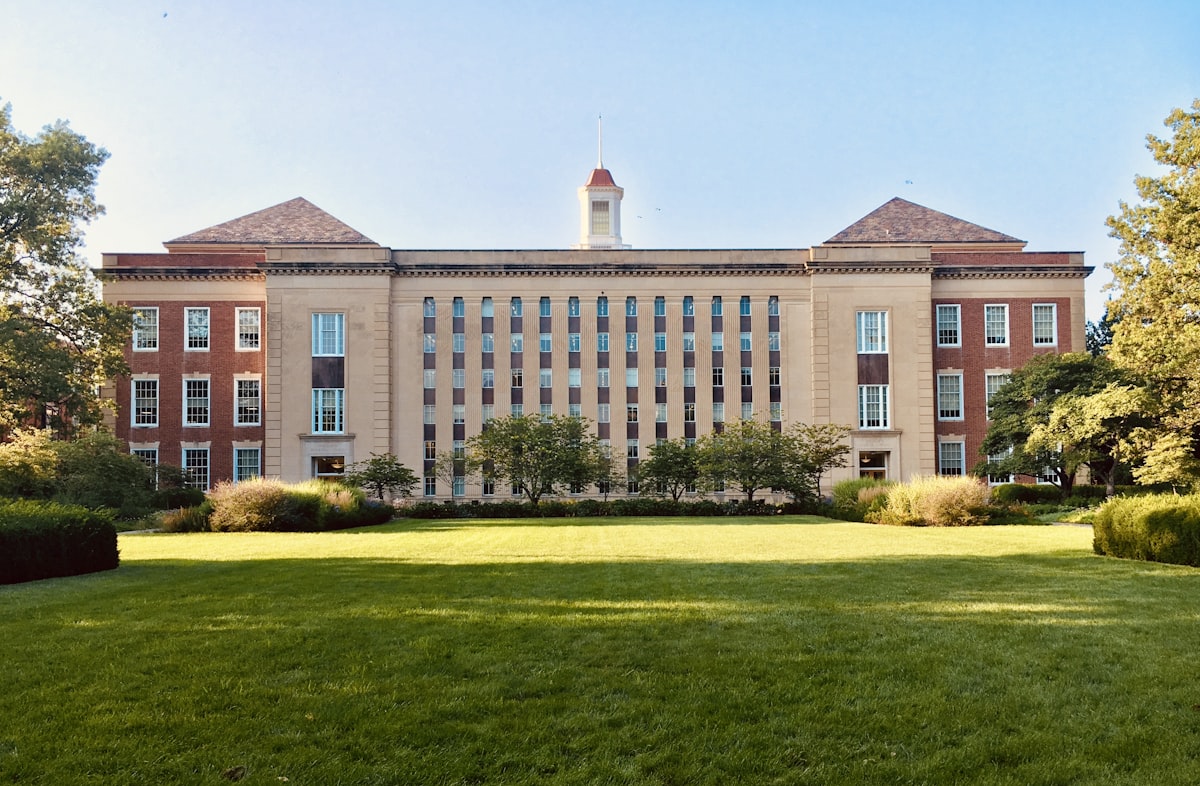
Our 12,000 m² campus in Peania occupies a refurbished former research site of the Hellenic Aerospace Industry. The campus opened to students in November 2025 and is being expanded in phases. The current footprint includes:
- Building A — Academic block with eight 80-seat lecture halls and twelve 30-seat tutorial rooms
- Building B — The Mechatronics Hall (800 m²) housing robotics, additive manufacturing, and propulsion labs
- Building C — Computer Science complex with five teaching labs and one 64-node compute cluster
- Building D — Civil & Structural laboratories, including a 200-tonne universal testing frame and a 4 m shake-table
- The Onassis Library — 22,000 physical volumes plus access to 18 major academic databases
- Sports facilities — outdoor 5-a-side football pitch, basketball court, and partnership access to Peania Municipal Pool
- Student Centre — café, study lounges, prayer/quiet room, and the EEA Bookstore

A second phase of construction, scheduled for completion in autumn 2027, will add Building E (a 4,500 m² combined energy systems and marine engineering wing) and a dedicated 250-bed student residence.